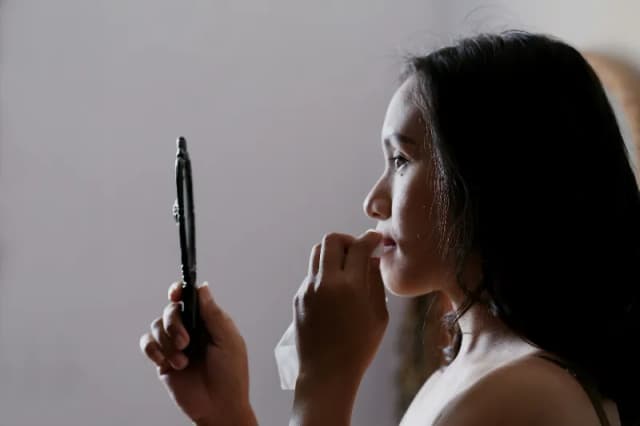
In our comparison-heavy world, full of TikTok influencers and unrealistic beauty standards, it's common to feel unattractive, or "chopped". However, most people may not realize just how common that feeling is.
In a dataset of 3,000 quiz responses, only 6% of participants landed in the “Definitely Not Chopped” category. The vast majority fell somewhere in the middle, with a smaller but notable group showing consistent self-critical patterns.
What makes this interesting is that participants didn’t simply label themselves, nor did the self-perception quiz analyze pictures of the participants. Instead, the quiz measured self-perception indirectly through patterns in how participants react to photos, compliments, flirting, eye contact, and social interactions.
To put it simply, only 6% of people received the "Definitely Not Chopped" answer because only 6% of people actually view themselves as "Definitely Not Chopped".

How the Quiz Measured Self-Perception
Instead of asking “are you chopped?” directly, the quiz looked at behavioral signals tied to confidence and self-image.
Questions included:
How you react to candid photos
Whether you make eye contact easily
How often you receive compliments
Whether strangers flirt with you
How you feel about selfies
How you interpret old photos of yourself
For example, a quiz-taker might select answers like:
“I look good in almost every candid photo.”
“People flirt with me constantly.”
“I post selfies and watch the likes roll in.”
These answers signal that the quiz-taker receives consistent external validation and feels internally confident.
In contrast, quiz-takers could choose other answers, such as:
“I immediately want to delete photos I see of myself.”
“I feel like I fade into the background in social situations.”
“I get friend-zoned quickly when I like someone.”
These answers indicate a very different self-perception pattern.
Based on the quiz-takers' answers, they were put into one of three result buckets:
You Might Be Chopped (indicating consistent, self-critical patterns)
Kinda Cute, Kinda Chopped (indicating a context-dependent sense of beauty and confidence)
Definitely Not Chopped (indicating a stable and consistently positive self-image)
Out of 3,000 responses:
83% landed in the middle, "Kinda Cute, Kinda Chopped" category
10% landed in the self-critical "Might Be Chopped" category
6% landed in the "Definitely Not Chopped" category.
What is striking is not that 10% of people feel that they're chopped, but rather that only 6% of people think they are consistently attractive.
Why Is Stable Confidence So Rare?
Only 6% of participants consistently displayed behaviors associated with strong, steady confidence.
That does not mean 94% believe they are unattractive. Instead, it means most people view their own attractiveness as situational. Psychology offers several explanations for ths.
The Spotlight Effect. Research by Thomas Gilovich and colleagues shows that people overestimate how much others notice their flaws. We assume our awkward moment is memorable. It rarely is.
Negativity Bias. Decades of research, including work by Roy Baumeister and others, show that negative feedback carries more psychological weight than positive feedback. One bad photo can override ten compliments.
Social Comparison Theory. Leon Festinger’s framework explains how we evaluate ourselves relative to others. In an environment saturated with filtered images and highlight reels, comparison becomes constant.
Put together, these forces create an unstable, inconsistent sense of confidence in your average person. Even someone who receives daily positive reinforcement may still feel conditional about their attractiveness. This doesn't mean there is something wrong with that person (or with you). Rather, it means this person is experiencing the documented psychological effects of living in a comparison-heavy culture.
The Meaning of the 83% Majority
The largest group of survey participants showed a large amount of variability.
People in the “Kinda Cute” range typically selected answers like:
“Sometimes I look great, sometimes not so much… depends on the angle.”
“I have to take 20 selfies to get 1 I like.”
“Approaching others gives me mixed results, depends on the vibe.”
If you're like most people, you probably read those and thought "hey, that's me". Having experiences like these doesn't mean that you're insecure or unattractive. It means that you are experiencing life in a very similar way to most people in your culture.
Attractiveness shifts with posture, energy, grooming, mood, and environment. Even confidence itself changes how someone is perceived. These results highlight the fact that it isn't realistic to feel good or attractive all of the time. We cannot simply label someone as "beautiful" and be done with it. Similarly, labeling someone (or yourself) as "chopped" is just as inaccurate.
What This Means for You
If you feel “chopped” sometimes, you are statistically normal. Only 6% of people consistently demonstrate stable, unwavering confidence patterns. The overwhelming majority fluctuate. That fluctuation doesn’t mean you’re unattractive. It means your self-perception changes with context, feedback, and comparison.
The data suggests a few simple conclusions: certainty is rare, conditional confidence is common, and you're probably not as "chopped" as you think you are. If you’re curious where your own patterns fall, you can take the full self-perception quiz and see how your answers map across those behaviors.
You might discover that what feels like being “chopped” is actually just being human in a comparison-saturated world. And according to 3,000 others, you’re not navigating that alone.
Methodology: Data derived from 3,000 anonymous responses to the “Am I Chopped?” self-perception quiz in 2025. Results categorized based on weighted behavioral response patterns.